

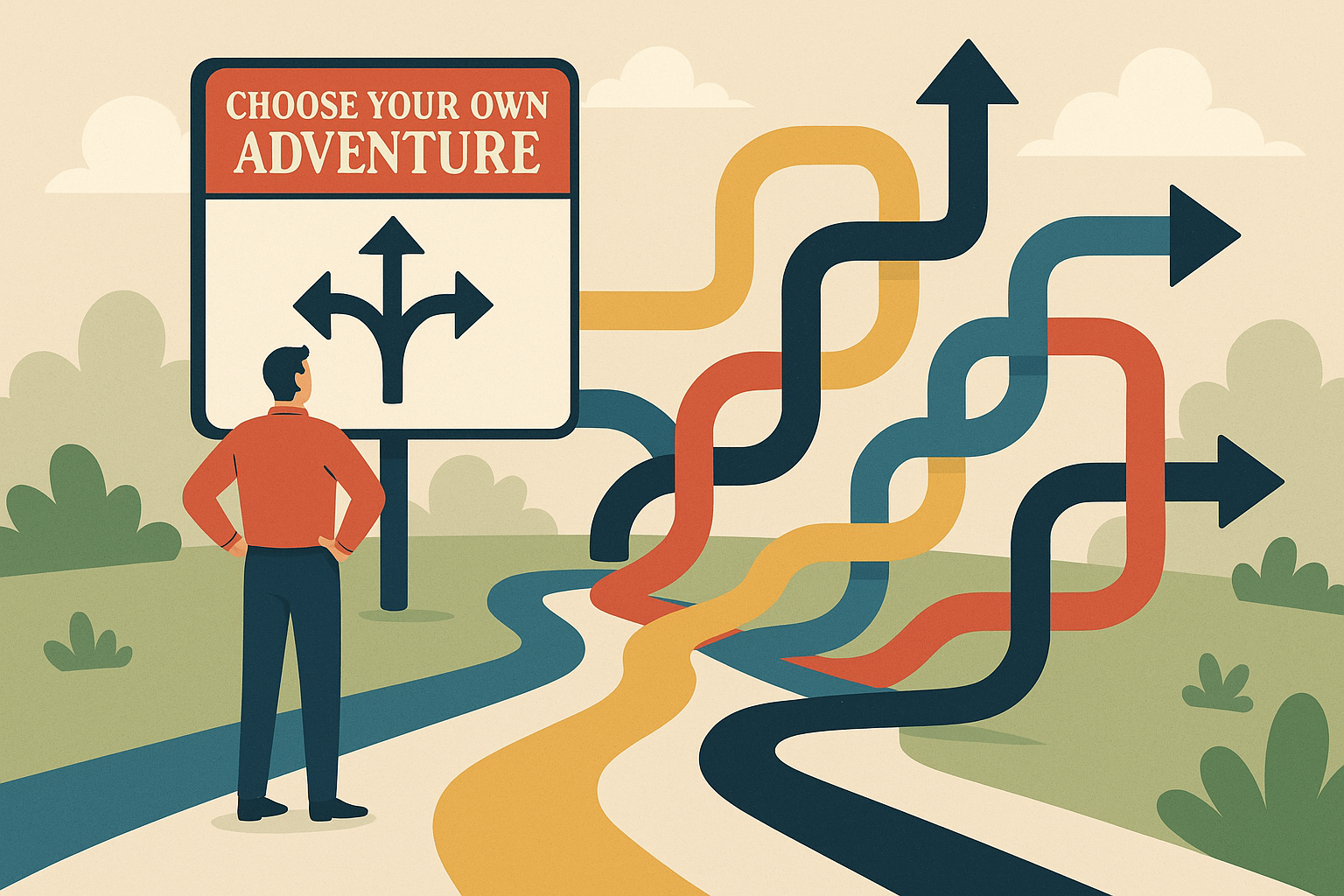
Customer Journey Transformation: From Funnels to Choose-Your-Own-Adventure
Confessions of a Marketer: The Board Game Analogy
Let’s start with a confession: I once tried to explain the modern customer journey to my kids using a board game. I set up Monopoly, mapped out the “awareness” square, the “consideration” railroad, and the “conversion” hotel. My 12-year-old promptly flipped the board, grabbed the dog token, and started making up her own rules. That, my friends, is exactly what’s happening in marketing right now — except the stakes are higher, and the tokens are your quarterly numbers.
- Customer Journey Transformation: From Funnels to Choose-Your-Own-Adventure
- Confessions of a Marketer: The Board Game Analogy
- The Death of the Linear Funnel
- Customers Take the Wheel
- Old Way vs. New Way: The Journey Remix
- AI as the New Bandleader
- Blurring the Digital and Physical Lines
- Co-Creation: The New Personalization
- AI: Scaling the Human Touch
- Predictive Personalization: The Real Opportunity
- The Future: Orchestrating Ecosystems, Not Controlling Journeys
- New Skills and Mindsets Required
- Final Lesson: Think Ecosystems, Not Funnels
- Welcome to 2025
The Death of the Linear Funnel
Here’s the headline: The classic, linear customer journey — that neat little funnel we all learned in Marketing 101 — is officially as outdated as fax machine advertising. The new reality? Customer journeys are co-created, adaptive, and powered by AI that’s less “Big Brother” and more “helpful concierge who knows you like oat milk in your latte and that you only run when chased.”
Customers Take the Wheel
So, what’s actually changing? In plain English: the customer is no longer a passenger on your carefully mapped-out brand road trip. They’re grabbing the wheel, fiddling with the GPS, and sometimes taking detours you didn’t even know existed. And the car? It’s now a self-driving Tesla with AI copilots, real-time data dashboards, and a playlist that updates based on their mood, location, and whether Mercury is in retrograde.
Old Way vs. New Way: The Journey Remix
- The old way: Brands built journeys like train tracks — straight lines, predictable stops, everyone gets off at the same stations.
- The new way: Journeys are more like improv jazz. Customers riff, brands respond, and the best experiences happen when you’re listening, not just playing your own tune.
AI as the New Bandleader
AI is the new bandleader. It’s orchestrating real-time experiences, interpreting every click, scroll, and eye-roll emoji to predict what your customer wants next. Maybe it’s a personalized offer, maybe it’s a chatbot that actually solves something, maybe it’s a virtual try-on that makes them look like a rockstar (or at least less like they just rolled out of bed).
Blurring the Digital and Physical Lines
And here’s the kicker: the line between digital and physical is now blurrier than my vision after three back-to-back Zooms. Customers might discover your brand in a VR showroom, try on your product in AR, and then buy it in a brick-and-mortar store — all before lunch. If your marketing still treats “online” and “offline” as separate planets, you’re basically sending smoke signals in the age of Starlink.
Co-Creation: The New Personalization
Why does this matter? Because the brands winning today aren’t just “personalizing” — they’re co-creating. They’re letting customers shape their own journeys, pivoting in real time when priorities shift (price, sustainability, convenience, or just a sudden craving for pumpkin spice). The best marketers aren’t directors yelling “Action!” — they’re facilitators, setting the stage and letting the audience improvise.
AI: Scaling the Human Touch
Now, let’s talk about the elephant in the room: AI. Yes, it’s everywhere. Yes, it’s powerful. But here’s the truth nobody wants to say out loud at the martech conference: AI isn’t here to replace the human touch. It’s here to make it scalable. The smartest brands are using AI to automate the boring stuff (think: form fills, authentication, “where’s my order?”) so their people can focus on the moments that actually build loyalty.
Ally Financial, for example, is using AI to handle routine tasks, freeing up humans to do what humans do best — connect, empathize, and occasionally crack a dad joke.
Predictive Personalization: The Real Opportunity
But don’t get seduced by the shiny object syndrome. AI is only as good as the data and intent behind it. If you’re using it to blast generic offers or automate bad experiences faster, congratulations — you’ve just built a smarter spam cannon. The real opportunity is in predictive personalization: using AI to anticipate needs before the customer even articulates them.
Imagine a skincare brand that recommends a new product because it picked up on social signals about your upcoming beach trip. That’s not just marketing — that’s magic.
The Future: Orchestrating Ecosystems, Not Controlling Journeys
Here’s my take: The future of marketing isn’t about controlling the journey. It’s about orchestrating an ecosystem where customers feel empowered, understood, and — dare I say it — delighted. The brands that win will be the ones that treat every interaction as a two-way conversation, not a one-way broadcast. They’ll blur the lines between digital and physical, automate the friction, and use AI to turn data into empathy at scale.
New Skills and Mindsets Required
But let’s not kid ourselves: this isn’t easy. It requires new skills, new mindsets, and a willingness to let go of the illusion of control. It means investing in real-time data, cross-channel identity resolution, and creative teams who can riff with the best of them. It means measuring what matters (participation, advocacy, lifetime value) instead of vanity metrics that look good on a dashboard but don’t move the needle in the real world.
Final Lesson: Think Ecosystems, Not Funnels
So, what’s the lesson for marketers staring down Q4 with a mix of hope and heartburn? Stop thinking in funnels. Start thinking in ecosystems. Your customer isn’t waiting for you to hand them a map — they’re already exploring, experimenting, and expecting you to keep up. The question isn’t whether you’ll adapt. It’s whether you’ll do it fast enough to stay relevant.
And if you’re still clinging to that old Monopoly board, just remember: in the new marketing game, the only rule is that the rules keep changing. The winners? They’re the ones who know how to improvise, listen, and — when the moment’s right — let the customer take the lead.
Welcome to 2025
Now, if you’ll excuse me, I have to go explain to my kids why the dog token is now running a DTC sneaker brand on TikTok. Welcome to 2025.